Issue No. 09 - THE CLARITY MEMO: Unfiltered.
Machines Can't Be Held Accountable.
Apparently, Neither Can We.
Founder’s Note: Issue No. 08 argued that your colleague, your consumer, and your community member are one person, badly managed from three rooms. This issue is about that same person being rated by machines, in every room all at once. I shared some of my frustration over the weekend; here, I address the underlying problem.
The Memo.
I submitted a media pitch last week and ran it through the platform’s embedded AI text checker. The score came back high enough that I knew it could not be right, so I ran the same text through three other tools. The results ranged from 5% AI-generated to 78%.
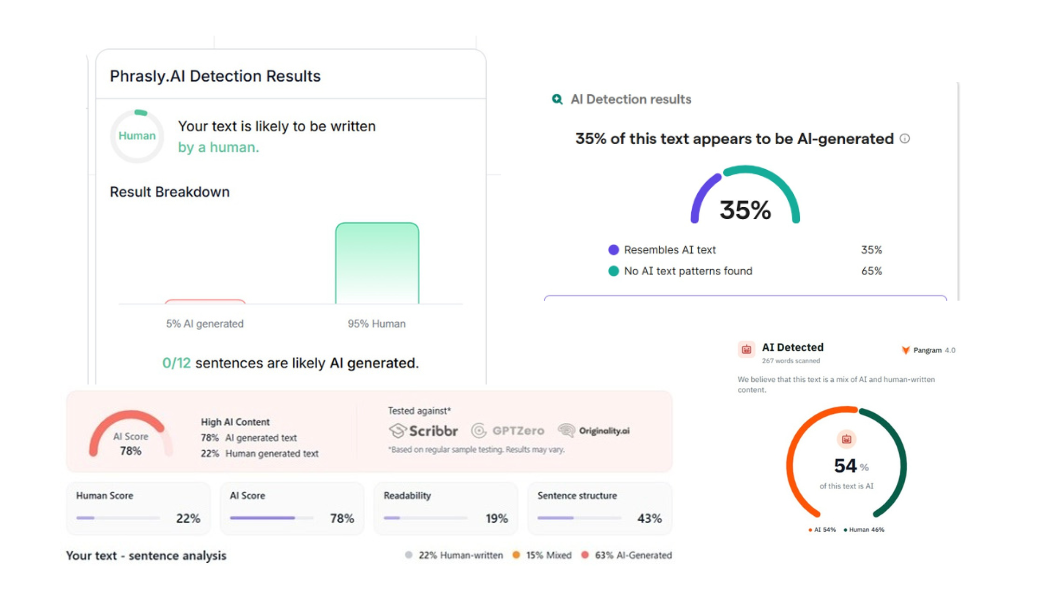
AI Text Detector: Run #1
Two days later I AI-checked a second pitch and two tools returned as 95% and 100% AI-generated, while the one the platform used returned 100% human-generated.
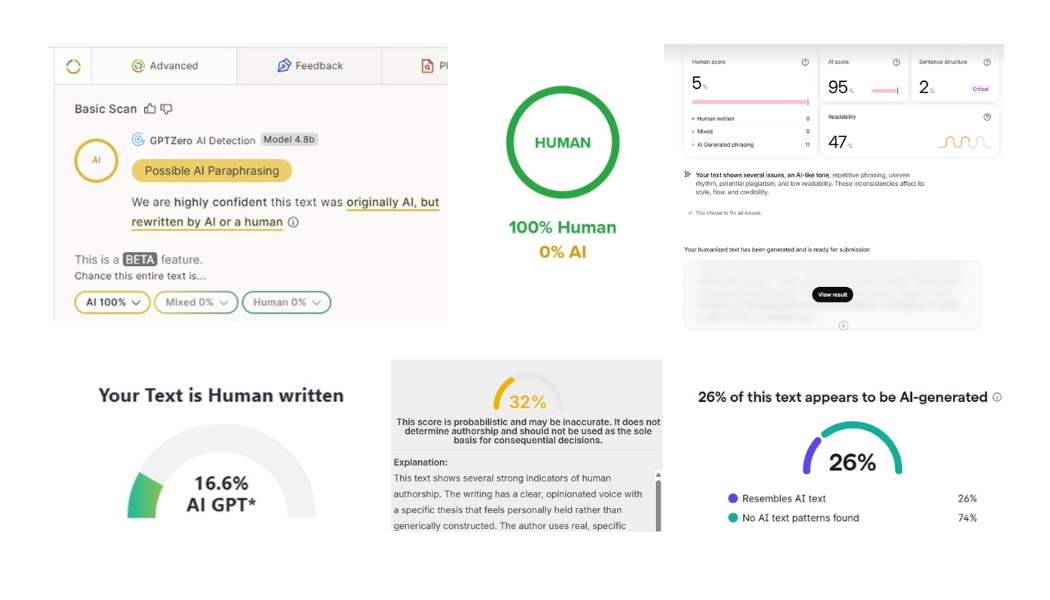
AI Text Detector: Run #2
These tools cannot agree with each other or detect what they claim to measure, because authorship now happens long before a final draft exists. What they measure is how closely a human’s sentences resemble an AI model’s output.
This made sense when authorship was binary, yet we have dismantled that on purpose. We build custom GPTs trained on our past work, load projects with our lived experiences and decades of writing, and ask the models to synthesize. We tell our teams to use these tools to amplify their thinking, and rightfully so. Then we turn around and judge the outputs with instruments that recognize only two possible authors – human or machine.
In June 2026, California listed an AI-writing detector among six high-risk automated decision systems in state use, filed alongside software that predicts whether an incarcerated person will reoffend.
In a 2025 Resume Builder survey of more than 1,300 managers, 91% said they use AI to assess employee performance, 88% use it to write performance improvement plans, and half use it to determine who gets promoted and who gets fired. 71% were confident in AI's ability to make fair and unbiased decisions about their people, a number your employees disagree with.
And SHL's 2025 research found that 58% of employees would rather be evaluated by a human, and 59% believe AI is making bias worse.
The Unfiltered Take.
Here is the loop this creates.
A human writes something, a machine flags the writing as machine-made, the same machine sells a “humanizing” upgrade behind a paywall, then the new text gets republished as “human.”
The tools that scored me highest as AI-generated were also selling the humanizing solution I would need to pass their own fabricated test. They profit from the unreliability twice, once when it flags you and again when it sells you the remedy. Besides, when these detectors check whether something is AI-generated, they’re testing for conformity to a default speech pattern and diction, not for human critical thinking, analysis, or judgment.
The tools promising to humanize content add no intelligence or intrinsic value, they simply cosplay as human. Which raises the question: whose humanity have we made the default standard?
These detectors are trained on a bodies of work that carry a dominant register, and writers who deviate from it – non-native speakers, code-switchers, anyone who writes perfectly because imperfection would be held against them – are the ones most likely to be flagged as machines. The detectors do not measure human authorship, they measure distance from a particular way of sounding educated.
What I did not tell you earlier is that I edited my first pitch anyway, knowing the score was wrong, because I also knew my acceptance depended on it. I am still sitting with whether I made the right call because these detectors do not need to be accurate to change human behavior.
Which brings me to your organization. Every leader reading this has an employee adjusting their writing to pass a machine, and a manager using a machine to evaluate that employee.
Employee trust is already thin before we layer on the machines. Leaders struggle to catch halo, recency, and affinity bias in performance measurement even after years of practice, so a model trained on the data those biases produced cannot catch them either. It simply inherits the delusion and returns it with unearned confidence. Your teams are not resisting technology, no matter what your change management report says. They are asking to be seen by a person who can accurately account for the year they actually had. Which is also, I suspect, part of why your AI adoption strategy is failing in ways you cannot explain.
And all of this runs with almost no oversight.
The 2026 NFP U.S. Benefits Trend Report found that only 28% of employers have a comprehensive AI governance policy and 29% conduct bias audits. Logicalis found that nearly nine in ten companies are increasing AI budgets, while fewer than one in six have governance at the C-level. To be clear, a documented governance AI policy is not the same thing as human oversight. A governance policy is a collection of paragraphs on paper, and oversight is a person being accountable for the human impact AI use creates.
A system that cannot reliably tell whether a machine or a human wrote something is now writing the permanent record of who your people are, how they perform, and what happens to them next. And few leaders are being asked, or are willing, to stamp their names on these systems.
I edited that first pitch because the score stood between me and the “yes” I wanted, despite knowing the score was wrong. Somewhere in your organization, someone has been making that same edit all year, diluting the sentences that sound most like them so a machine will let them through. You are paying premium salaries for original thinking, and ending up with a team that sounds and thinks like no one in particular.
The Action.
Pull one report your AI tools flagged this quarter – low engagement, poor collaboration, whatever the label was. Before you act on it, have the conversation the machine could not have.
Then ask yourself whether the label still applies, and who would have been accountable if you had never asked.
The Clarity Memo: Unfiltered drops bi-weekly. Subscribe to get it directly to your inbox.
This content is for informational purposes only and does not constitute professional, legal, financial, or organizational advice. For guidance specific to your organization, contact Fadéké Strategic Consulting, LLC at admin@fadeke.com